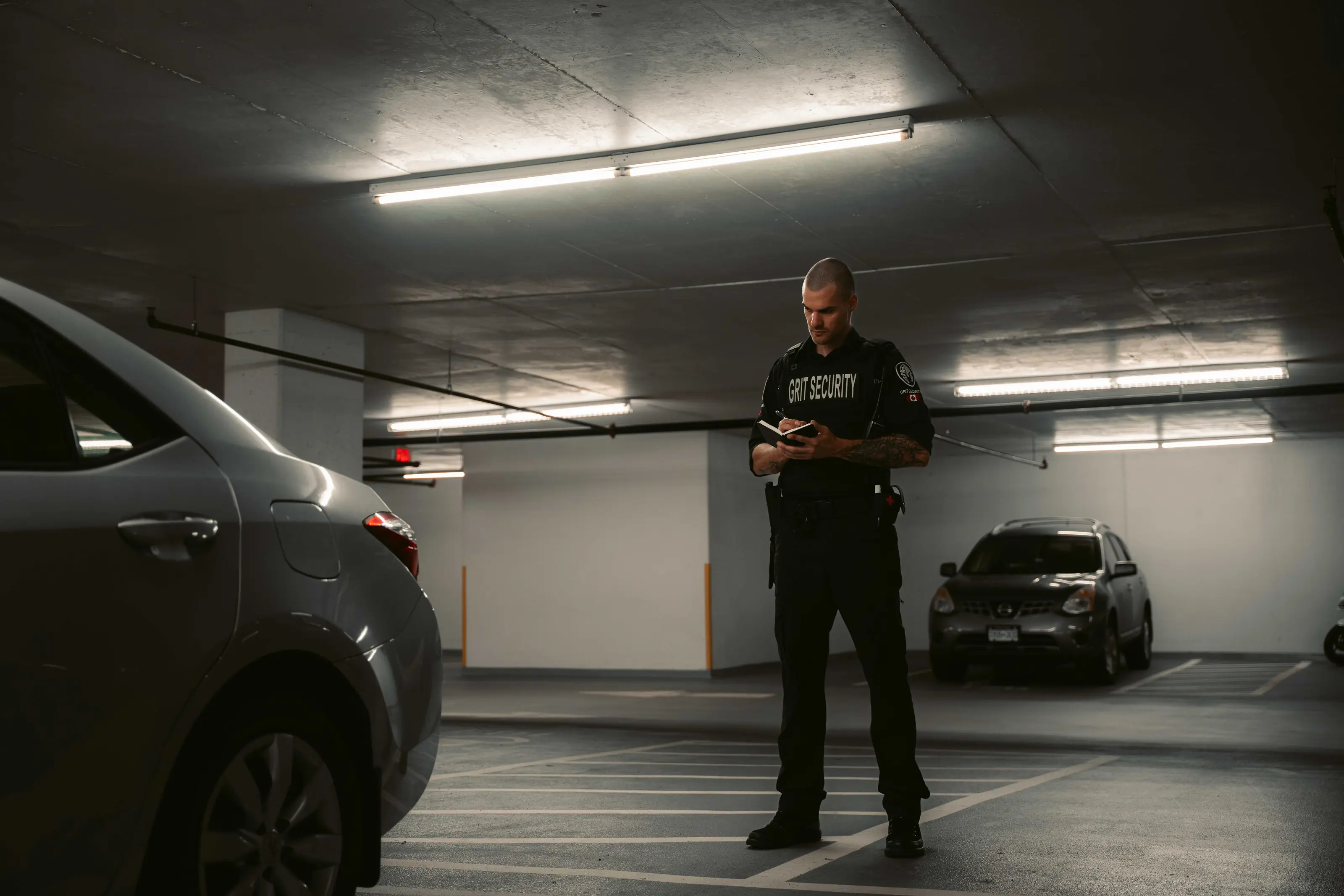
Parking areas combine vehicle movement, pedestrian traffic, restricted doors, elevators, payment equipment and long sightlines in one operating space. A useful security plan connects those conditions to clear inspections, documented patrols, working systems and an escalation process that property staff can follow.
This checklist is written for surface lots, underground parkades and multi-level parking structures. It helps property managers turn a broad instruction such as “check the parking area” into specific, verifiable duties.
1. Define the operating picture
Start with the way the parking area functions during a normal day. Record the opening and closing times, public and restricted levels, monthly and visitor parking, loading activity, deliveries, bicycle storage, electric-vehicle charging, accessible spaces and connections to the building.
Then identify the periods when conditions change. These include shift changes, tenant opening and closing times, event arrival and departure, contractor work, waste collection and periods with low occupancy. The plan needs named coverage windows rather than a single risk label for the entire day.
List who has responsibility for each part of the property. Ownership must be clear for gates, lighting, elevators, cameras, emergency phones, payment equipment, signage, snow and ice removal, cleaning, towing and incident escalation.
2. Map every route and access point
Create a current site map and mark:
- Vehicle entrances and exits
- Pedestrian doors and walkways
- Elevator lobbies and stairwells
- Pay stations, intercoms and emergency phones
- Loading bays and service corridors
- Bicycle rooms, storage areas and mechanical rooms
- Gates, roll-up doors and access-controlled barriers
- Camera locations and visible coverage gaps
- Fire routes, muster points and emergency access lanes
For each point, state the authorized condition. A door is not simply “checked”; it is confirmed locked, unlocked, alarmed or accessible according to the approved schedule. A gate check records whether the barrier closes fully, the reader responds and the lane remains clear.
3. Inspect lighting, sightlines and physical conditions
Lighting supports pedestrian safety, camera visibility and officer observation. The Canadian Centre for Occupational Health and Safety parking-lot guidance identifies good lighting, sound walking surfaces, clear markings and removal of debris from drains and grates as core controls.
During a documented inspection, record the exact fixture or area affected by a lighting failure. “Light out in parkade” does not provide enough detail for repair. A useful entry identifies the level, row, stall, stairwell, doorway or fixture number and states whether the failure creates a dark approach, blind corner or camera-visibility problem.
Check for objects that block views at pedestrian crossings, gate approaches, elevator lobbies and stairwell doors. Keep mirrors, signs and height-clearance bars clean and correctly positioned. Report potholes, damaged wheel stops, loose covers, standing water, ice, debris and faded traffic markings through the property’s maintenance process. The CCOHS outdoor inspection checklist also calls for adequate lighting, clear fire-route signs, parking areas free from trip hazards and properly functioning security systems.
4. Test access controls as an operating system
Access control includes the reader, credential, gate, door hardware, intercom, timer, override process and the people responsible for responding. Test the full sequence rather than one component.
- Confirm authorized credentials open the correct entrance.
- Confirm the gate or door closes and latches after entry.
- Check for tailgating opportunities at slow-closing barriers.
- Confirm visitor and delivery procedures match the approved access list.
- Verify lost, stolen and expired credentials are removed through the management process.
- Record manual override rules and the person authorized to approve them.
- Keep emergency routes and fire-service access clear.
A broken gate changes the property’s risk profile immediately. The temporary plan needs a start time, an assigned observation or patrol duty, a repair contact, escalation thresholds and a clear end point once normal operation is restored.
5. Review camera coverage against real tasks
Camera placement needs to support defined review and response tasks. Confirm that views cover entrances, exits, pay stations, elevator approaches, stairwell doors, loading areas and lanes where vehicles or people enter restricted sections.
Record the date and time settings, image clarity, obstruction, retention settings and authorized review process. A camera that records the wrong time weakens incident reconstruction. A camera blocked by glare, dust, a new sign or a parked vehicle leaves a gap even when the system reports that the device is online.
Set a process for footage preservation. The procedure identifies who receives a request, who is authorized to export footage, what time window is preserved, where the file is stored and how the action is documented.
6. Build a patrol route that verifies conditions
A patrol route needs defined observation points and tasks. Use the site map to establish checks across vehicle entrances, pedestrian doors, stairwells, elevators, blind corners, bicycle storage, loading areas, mechanical access and the exterior perimeter.
Varying the route or timing reduces predictability, while fixed checks protect duties tied to closing, scheduled access or a known operating window. The post orders must identify which checks are fixed, which are varied and which conditions trigger an extra patrol.
Each patrol entry should record:
- Date, time and officer
- Level, zone or checkpoint
- Door, gate, lighting and equipment condition
- People, vehicles or activity requiring attention
- Action taken and person notified
- Photographs or system references authorized by the site procedure
- Open follow-up item and responsible contact
A checkpoint scan verifies attendance at a location and time. The written observation verifies the condition found and the action taken.
7. Define response rules before an incident
Write direct instructions for common events:
- Gate or door failure
- Unauthorized access or tailgating
- Vehicle collision or property damage
- Person in medical distress
- Fire alarm or emergency-service attendance
- Suspicious activity or attempted theft
- Blocked fire route or loading lane
- Lighting outage or camera failure
- Water leak, ice, debris or another safety hazard
For each event, identify the first action, emergency threshold, management contact, maintenance contact, towing contact, police or fire contact process, evidence-preservation step and reporting deadline. Emergency calls take priority over written reporting.
Officers need a current contact list and a clear sequence for unanswered calls. Record every contact attempt with the time, number or person contacted and instruction received.
8. Separate observation, enforcement and maintenance
Parking operations involve different authorities. The security plan must distinguish observation and reporting, access enforcement, parking-rule enforcement, towing authorization, maintenance requests and emergency response.
State who has authority to issue warnings, approve towing, open a restricted door, release a vehicle, review footage and grant contractor access. Security personnel should not assume an authority that the property has not assigned in writing.
In British Columbia, security guards must be licensed. The Security Services Act sets the licensing requirement for security work. The site plan must also match the property’s approved procedures, contracts and emergency responsibilities.
9. Protect pedestrians and personnel during patrols
Patrol instructions must account for moving vehicles, ramps, blind corners, low light, weather exposure and lone work. Use designated walkways where provided, face traffic when the route permits and avoid standing in vehicle lanes while recording notes or using a device.
High-visibility clothing, working communication equipment and a check-in process support personnel who work around vehicles or complete isolated patrols. The assignment needs a missed-check-in escalation step and a supervisor contact.
Do not create a patrol route that requires an officer to enter an unsafe area without support. The post orders need a withdrawal point, emergency call procedure and direction for preserving observation from a safe position.
10. Use reporting to close recurring gaps
Individual reports document one condition. A consistent review process identifies repeated lighting failures, gate faults, door-propping, loitering, unauthorized access, camera obstruction, drainage problems and conflicts during the same operating window.
Review patrol and incident records on a set schedule. Assign each open item to property management, maintenance, security supervision or another named owner. Close the item only after the repair, procedure change or follow-up action is confirmed.
Track the time between discovery, notification, temporary control and final resolution. This shows where the response process stalls and where the property needs a clearer contact or authority.
Parking security checklist for property managers
- Is the site map current and are all entrances, exits and restricted doors marked?
- Are operating hours and high-activity periods documented?
- Are gates, readers, intercoms and door hardware tested as one sequence?
- Are lighting failures recorded with an exact location?
- Are pedestrian routes, stairs, ramps and crossings clear?
- Do camera views support the property’s review and response tasks?
- Is there a documented process for footage preservation?
- Does the patrol route cover defined checkpoints and observation duties?
- Are fixed and varied patrol checks identified?
- Are emergency thresholds and contact sequences written?
- Is towing and parking-enforcement authority clear?
- Are security, maintenance and property-management responsibilities separated?
- Is a lone-worker check-in and missed-check-in process active?
- Are open issues assigned and tracked to confirmed resolution?
Frequently asked questions
How frequently should a parking area be patrolled?
The schedule should follow the property’s operating hours, access patterns, incident history and assigned coverage. Post orders should identify fixed checks, varied checks and the conditions that trigger an extra patrol.
What should an officer check during a parkade patrol?
The patrol should cover assigned doors, gates, stairwells, elevators, lighting, cameras, pay equipment, pedestrian routes, restricted areas, vehicles or activity requiring attention and outstanding maintenance or security concerns.
Does a camera system replace physical patrols?
No. Cameras support visibility, review and evidence preservation. Physical patrols verify door, gate, lighting, safety and access conditions that a camera view does not establish on its own.
Who should authorize towing?
The property must identify the authorized decision-maker and approved towing procedure in writing. Security personnel follow that authority and document the reason, approval, time and service contacted.
Grit security services
Properties can connect the checklist to verified mobile patrol security for scheduled or varied checks and uniformed security guards for dedicated on-site coverage. Duties, checkpoints, reporting and escalation are defined in property-specific post orders.
Service locations
Grit Security provides service information for Vancouver, Burnaby, Richmond, Surrey, Langley, Coquitlam, Delta, Victoria and Nanaimo.
Turn the checklist into a working plan
A strong parking security plan assigns every check, response and follow-up step to a named role. Review Grit Security’s parking security services and request a security consultation to build coverage around the property’s access points, operating hours and reporting requirements.